
How to Choose Kitchen Cabinets for a North Jersey Home
Most people start cabinet shopping at the door. It is the part you can see, so it is the part that gets the attention — shaker or slab, white or walnut, handles or handleless. Understandable, and mostly backwards.
The door is the easiest thing to change your mind about and the least important to the life of the kitchen. What determines whether your cabinets still look right in fifteen years is what is behind the door: how the box is built, what the hinges and glides are, and whether the whole thing was specified to fit your actual house rather than a showroom display.
Here is how we would think it through, in the order that matters.
Start with the box
Cabinet boxes are built from plywood or from particleboard and MDF. Plywood holds a screw better, tolerates moisture better and does not sag under a heavy stone countertop over time. Particleboard is not automatically bad — a well-made particleboard box from a good manufacturer will outlast a badly made plywood one — but under a sink, next to a dishwasher, or carrying quartz, plywood is the safer specification.
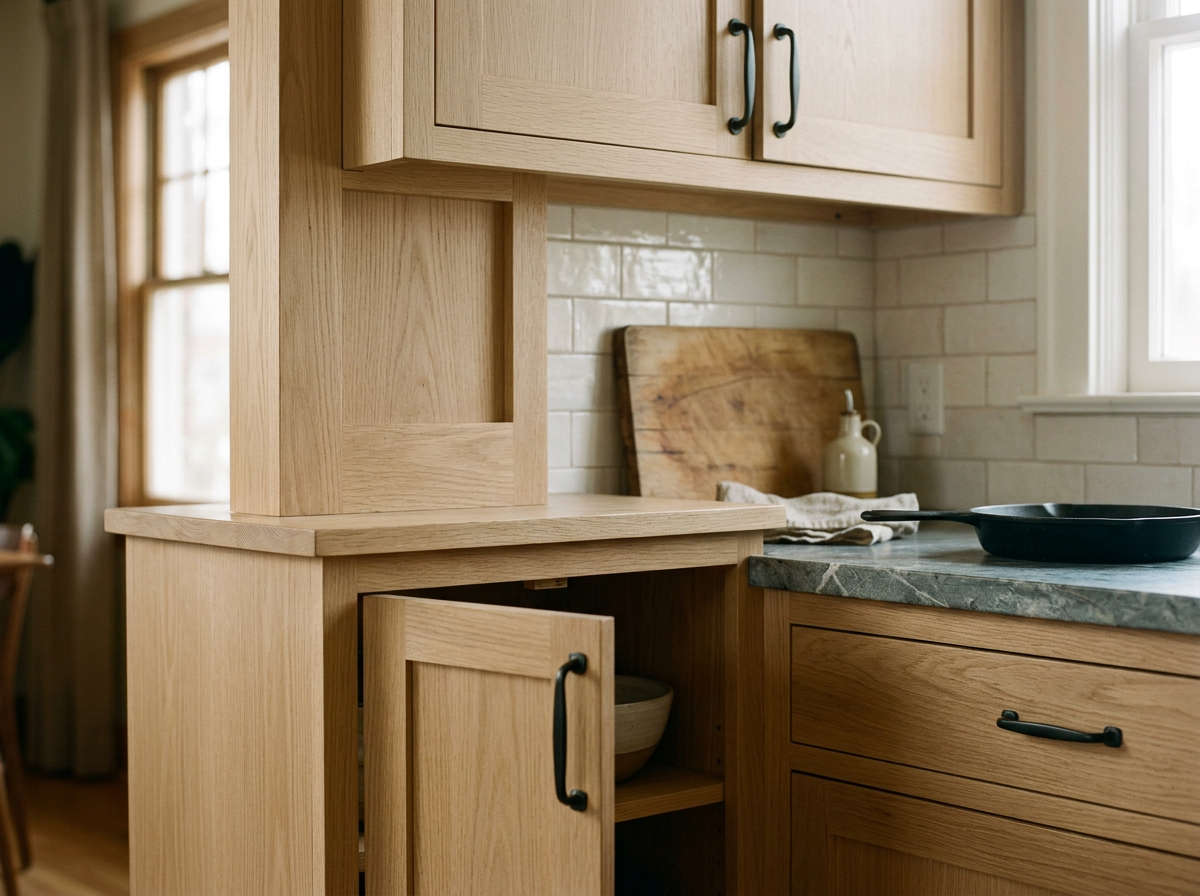
Open a drawer in the showroom and look at the joinery. Look at whether the back panel is a proper captured panel or a thin sheet stapled on. Look at whether the shelves flex when you press on the middle. These are two-minute checks and they tell you more than any brochure.
Hinges and drawer glides matter just as much. Soft-close on both should be standard, not an upgrade, and undermount full-extension glides are worth having because they let you actually reach the back of a drawer.
Framed or frameless?
A framed cabinet has a face frame across the front of the box. It is the traditional American construction, it suits a colonial or an older center-hall house, and it is very forgiving of walls that are not quite square — which, in a lot of North Jersey housing stock, is a real advantage.
A frameless cabinet has no face frame. The opening is the full width of the box, so you get noticeably more usable space and a flatter, more continuous line across a run. It is the European approach and it is what most contemporary kitchens are built from.
Neither is better. They are different, and the right one depends on the house and the look you are after. If you like the flat-front, handleless, seamless kitchen, you want frameless.
Door styles that age well
Shaker is popular because it is genuinely hard to get wrong. A simple recessed panel sits comfortably in a 1920s colonial and in a new build, and it has survived every trend cycle of the last century.
Slab doors are the other safe choice at the opposite end — no profile at all, so nothing to date. They read as modern, but they also read as calm, which is why they work in more houses than people expect.
Raised panel and heavily profiled doors are more specific. They can be beautiful in the right house and they can look tired quickly in the wrong one.
One piece of practical advice: the more detail a door has, the more places dust and cooking grease find to settle. If you cook seriously, a flatter door is less work forever.
Finishes: what holds up in a real kitchen
Painted white and off-white remain the most requested finish and for good reason — they make a small kitchen read larger and they go with everything. They also show every chip, and touch-up on a factory-painted door is never invisible.
Stained wood hides wear far better and has come back strongly, particularly in warm mid-tones on islands and lower runs.
High gloss is dramatic and reflective, and it shows fingerprints. Modern supermatte finishes solve exactly that problem — they are engineered to resist fingerprints and have a soft, low-sheen surface that looks like nothing else.
Two-tone kitchens — a different colour on the island or the lowers — are a good way to get some depth without committing the whole room to a strong colour.
Let the house have a say
This is where a lot of otherwise good kitchens go wrong. A high-gloss handleless kitchen in a 1930s colonial with original trim and plaster detail can work, but it takes a confident hand. Dropped into that house casually, it just looks like it belongs somewhere else.
Older North Jersey houses tend to bring specific realities: ceiling heights that are lower than you would like, walls that are not plumb, radiators in inconvenient places, and chimney chases that cannot move. Newer construction brings its own — open plans where the kitchen is visible from the living room, which means your cabinetry has to read as furniture from twenty feet away.
Either way, the house should be part of the decision. Measure it, photograph it, and bring both.
Buy from somewhere you can go back to
Cabinets are not a one-transaction purchase. Something will arrive scuffed, a hinge will need adjusting after a season, you will want a matching panel two years later when you replace the dishwasher.
A local showroom that specified the job can pull the original order, identify the exact finish and handle the manufacturer claim on your behalf. A big-box order placed online cannot do any of that, and neither can a supplier three states away.
That is the real argument for buying locally, and it has nothing to do with sentiment.
Come and open some drawers
Everything above is easier to judge in person than on a screen. Finishes photograph badly, weight and solidity do not photograph at all, and the difference between a good drawer and a cheap one is something you feel in about a second.
Bring your dimensions and a few photos of the room. We carry Forevermark, GoldenHome, Cabnova and Alvic, and we will tell you honestly which of them suits your house rather than which one we would rather sell.
GM Interiors, 6 Kingsbridge Rd, Unit 5, Fairfield NJ 07004. We design, supply and install across Bergen, Passaic, Essex and Morris counties.
